AI Sales Automation
WhatsApp AI Sales Assistant
Built an AI-assisted WhatsApp sales system that handles early conversations, preserves customer context, qualifies leads, updates CRM data, and hands complex or high-intent conversations to a human team.
The first sales conversation was carrying too much manual work.
Every new WhatsApp inquiry required someone to answer recurring questions, understand the project, collect customer context, judge early intent, update lead records, and know when the conversation should move to a person.
Service, process, and early project questions repeatedly needed a manual response before a useful sales conversation could begin.
Without structured memory and lead lookup, the team risked asking the same questions again or losing earlier project context.
Location, project type, needs, budget signals, and readiness needed a more consistent way to enter the sales process.
Consultation, technical questions, costing, site-survey requests, and explicit human requests should not stay inside an automated reply loop.
AI handles the repeatable first mile. Humans take over where judgment matters.
This card covers the live inbound conversation layer. Scheduled lifecycle nurturing after a conversation slows down is documented separately in the Lead Nurturing & Follow-Up Automation system.
Built for a cleaner handoff from chat to sales.
The assistant uses customer history, conversation memory, and service knowledge instead of treating every message as a fresh start.
The workflow can capture and organize customer context such as location, project type, needs, budget signals, questions, objections, and lead status.
Recurring questions can be answered from the connected knowledge source while uncertain or project-specific topics are escalated instead of invented.
Consultation-ready, technical, costing, site-survey, or explicit human requests can pause the AI and move the conversation to a person.
A custom web inbox gives the team a real interface to monitor conversations, see bot state, and take over manually.
Lead identity and structured context are preserved across the sales stack, with Supabase becoming the richer operational backend while legacy Sheets workflows still coexist.
The workflow is working before public traffic is opened.
Current evidence is based on internal workflow validation and the real business infrastructure. No customer-scale conversion, revenue, or response-time impact is claimed yet.
Less scattered activity. More operating clarity.
A team member handled every incoming conversation manually.
The AI can handle repeatable early-stage conversation and information collection.
Important details were easy to repeat, miss, or leave inside chat history.
Customer context can be carried through memory, CRM state, and structured extraction.
Qualification depended heavily on the individual handling the chat.
Lead context is captured through a more consistent qualification workflow.
Human takeover depended on someone noticing that the conversation needed attention.
Defined handover conditions can pause the AI and alert the internal team.
A Cloud API number did not provide the team with a normal native chat inbox.
A custom inbox provides live visibility, bot state, and manual takeover.
Real operating artifacts, not a chatbot mockup.
The screenshots show the inbox, simplified workflow, and an internal conversation example. Public-scale performance is intentionally not claimed before launch.
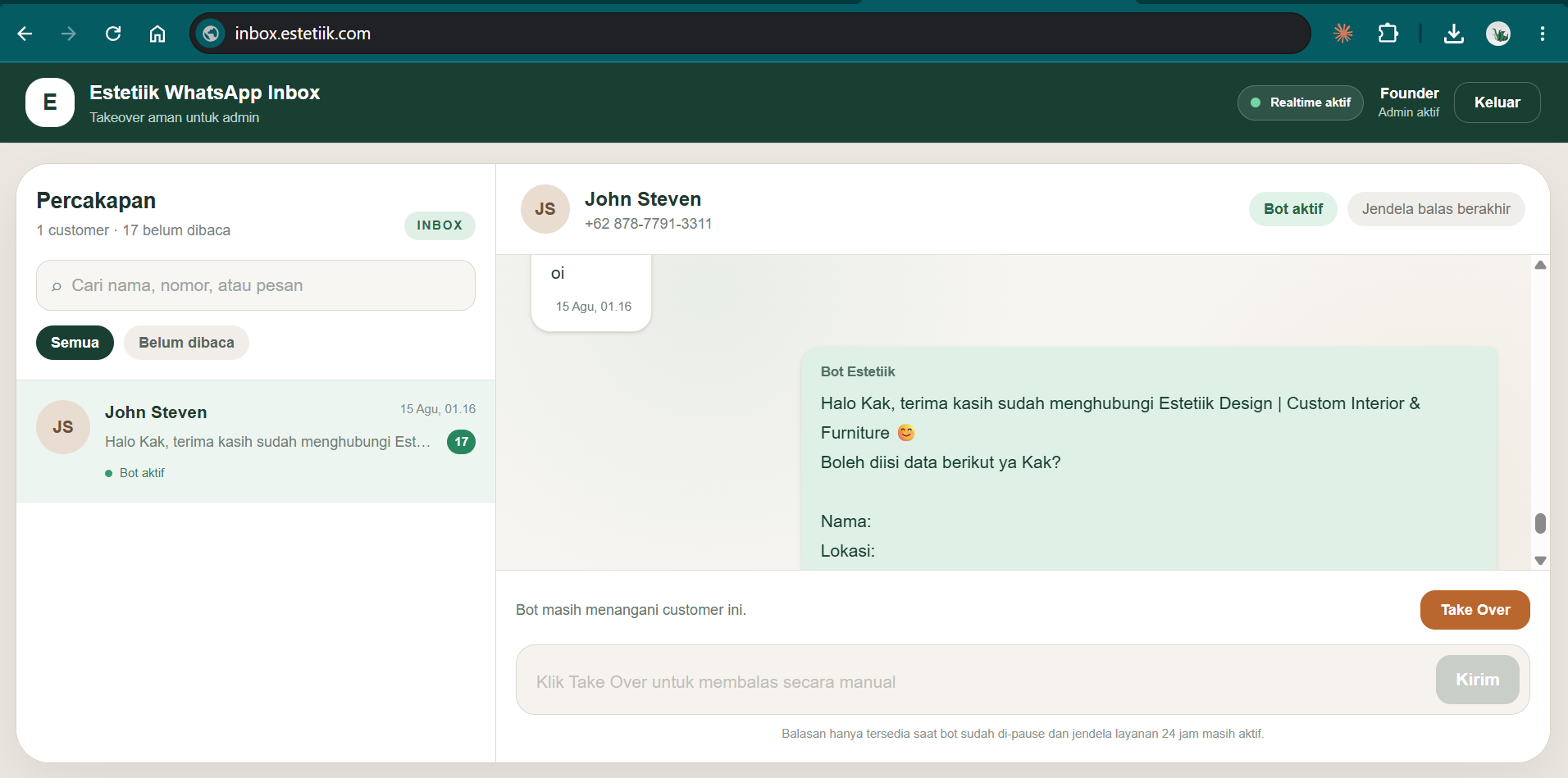
The team can monitor the conversation, see whether the bot is active, and take over manually when needed.
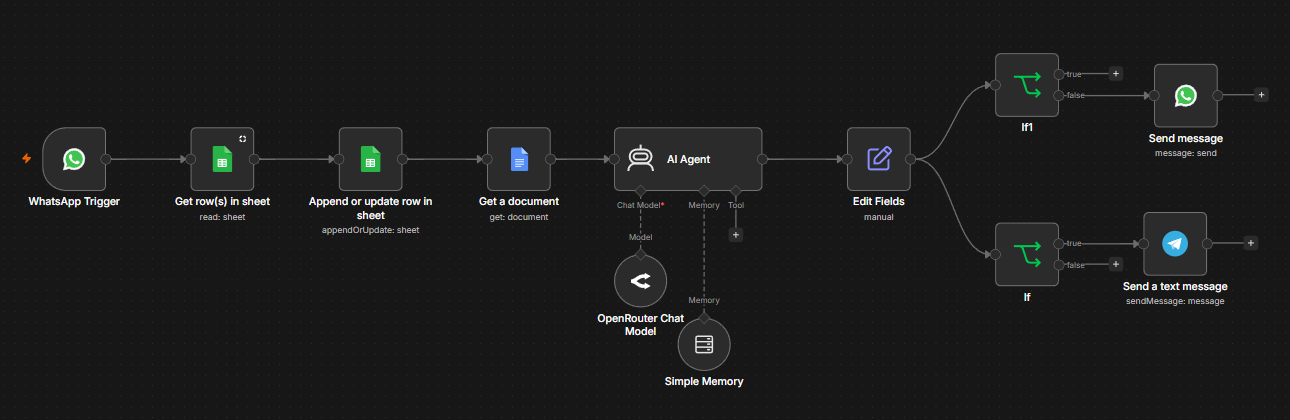
A simplified view of context lookup, AI response, qualification, CRM update, and human handover.
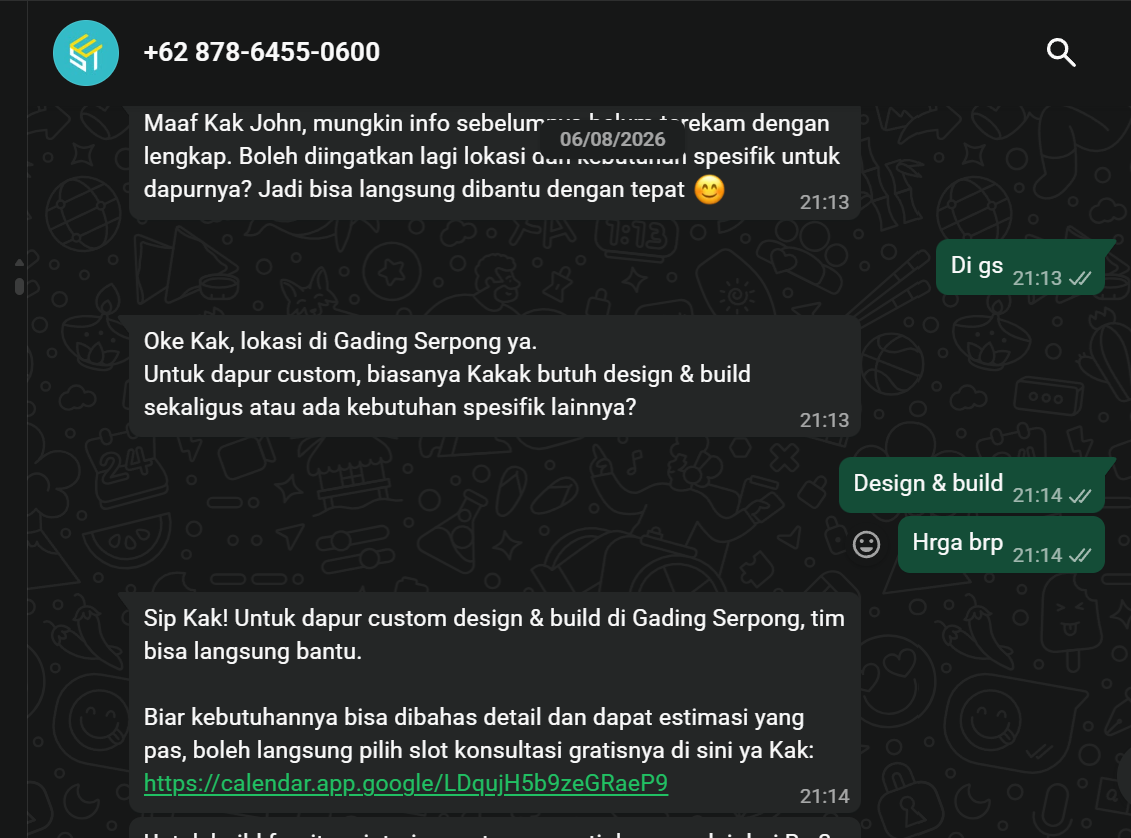
Example of the assistant handling an early-stage conversation before public campaign traffic is enabled.
Production-ready, pre-public launch
- The workflow runs on the real WhatsApp Cloud API business number and business infrastructure.
- Inbound conversations, context lookup, qualification, CRM updates, and human handover have been built and internally tested.
- The custom Inbox App provides the team with live conversation visibility and manual takeover controls.
- Supabase now supports the operational CRM and inbox layer, while Google Sheets remains part of the current stack during migration and compatibility work.
- The system has not yet been opened to public or paid-campaign traffic, so no customer-scale outcome is claimed.
Validate at real customer volume
- Open the system to controlled public traffic and measure response quality, data-capture accuracy, handover quality, and operational reliability.
- Continue consolidating CRM data into the Supabase-backed operating layer while preserving any legacy workflow that still depends on Sheets.
- Use richer CRM and attribution data later to evaluate lead quality across the full acquisition-to-sales journey.
- Keep scheduled outbound nurturing as a separate specialist system instead of mixing it into this inbound-conversation case.
Key takeawayThe useful role of AI in sales is not to replace the consultation. It is to make the first conversation more consistent, preserve context, and know when a human should take over.
Start a conversation